I Grew Up in a Medieval Village Without Ever Thinking It Was Extraordinary
Il m’a fallu devenir prof de FLE pour réaliser que mon enfance n’avait rien d’ordinaire.
J’ai grandi à Saint-Marcellin-en-Forez. Pas un village dont on parle dans les guides touristiques. Pas un endroit où les autocars déversent des centaines de visiteurs chaque jour. Juste… mon village.
Pendant mes onze premières années, j’allais à l’école à pied. Mon trajet passait devant l’église, dont les origines remontent au Xe siècle, puis le long des remparts médiévaux, mentionnés dès 1286 et renforcés au fil des siècles.
Je ne voyais pas des monuments historiques. Je voyais simplement le chemin de l’école.
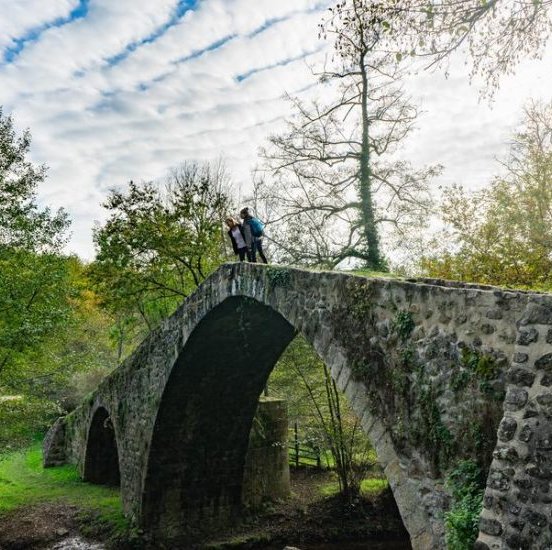
Le week-end, même adolescente, j’allais pique-niquer près du Pont du Diable. Pour nous, c’était un joli coin de nature. Ce n’est que bien plus tard que j’ai réalisé que ce pont de pierre, construit au XIVe siècle, était classé monument historique et entouré d’une vieille légende qui explique, comme souvent au Moyen Âge, que seul le Diable pouvait avoir bâti un ouvrage aussi audacieux.
Ma bibliothèque municipale ? C’était une ancienne chapelle. La chapelle Sainte-Catherine, datant du XIIe siècle, réhabilitée pour accueillir des livres. À aucun moment cela ne me semblait étrange.
À l’école primaire, nous avons même planté un arbre pour célébrer les mille ans de la première mention écrite du village. Je me souviens de cette cérémonie, mais je ne réalisais pas vraiment ce que signifiaient ces mille ans d’histoire. La première mention connue de Saint-Marcellin-en-Forez remonte à 984.
Tout cela faisait partie du décor. Un décor qu’on retrouve dans beaucoup de villages de ma région d’ailleurs.
Puis je suis devenue prof de français langue étrangère.
En parlant de la France avec mes étudiants,surtout les américains, j’ai commencé à comprendre la grandiosité de l’histoire de mon village qui pourtant n’intéresse pas les touristes!
« Tu allais à l’école en passant devant des remparts médiévaux ? »
« Ta bibliothèque était une chapelle ? »
« Tu as grandi dans un village qui existe depuis plus de mille ans ? »
Leurs questions m’ont fait comprendre quelque chose d’essentiel : ce qui est banal pour nous peut être extraordinaire pour quelqu’un d’autre.
Être prof de FLE m’a appris à regarder mon propre pays avec les yeux de mes étudiants. J’ai redécouvert mon village en même temps que je leur faisais découvrir la France.
Aujourd’hui, quand je retourne à Saint-Marcellin-en-Forez, je ne vois plus seulement le village de mon enfance. Je vois un lieu qui raconte mille ans d’histoire. Je me sens bien parce que c’est chez moi, mais aussi fière et un peu spéciale.
🇬🇧 English version
It took becoming a French as a Foreign Language (FLE) teacher for me to realize that my childhood was anything but ordinary.
I grew up in Saint-Marcellin-en-Forez, a small village in central France. It’s not the kind of place you’ll find featured in travel guides. It’s not a destination where tour buses unload hundreds of visitors every day. It was simply… home.
For the first eleven years of my life, I walked to school every morning. My route took me past a church whose origins date back to the 10th century, then alongside medieval town walls first mentioned in 1286 and strengthened over the centuries.
To me, they weren’t historical monuments.
They were just part of the walk to school.
On weekends, even as a teenager, I would go on picnics near the Devil’s Bridge (Pont du Diable). For us, it was simply a beautiful place to spend the afternoon. It wasn’t until much later that I learned this 14th-century stone bridge is a protected historic monument and surrounded by an old legend claiming that, as people often believed in the Middle Ages, only the Devil himself could have built something so impressive.
My local library? It was a former chapel.
The 12th-century Sainte-Catherine Chapel had been transformed into a public library. At the time, I never thought there was anything unusual about borrowing books in a medieval chapel.
When I was in primary school, we even planted a tree to celebrate the thousandth anniversary of the village’s first recorded mention. I remember the ceremony, but I didn’t truly understand what a thousand years of history meant. The earliest known written record of Saint-Marcellin-en-Forez dates back to the year 984.
All of this was simply part of the scenery.
And, in fact, it’s a scenery shared by many villages across my region.
Then I became a French as a Foreign Language teacher.
As I talked about France with my students—especially my American students—I began to realize just how remarkable my village’s history really is, even though it’s a place that hardly attracts tourists.
“You walked to school past medieval walls?”
“Your library used to be a chapel?”
“You grew up in a village that’s over a thousand years old?”
Their questions made me realize something important: what feels completely ordinary to us can seem extraordinary to someone else.
Teaching French has taught me to see my own country through my students’ eyes. As I introduced them to France, I was rediscovering my own hometown.
Today, when I return to Saint-Marcellin-en-Forez, I no longer see only the village where I grew up.
I see a place that tells a thousand years of history.
I feel at home there, of course. But I also feel proud—and, in a way, a little bit special.